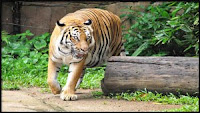
Malacca Zoo - The second largest zoo in Malaysia

on Tuesday, April 24, 2012

Zoo Melaka with an area of 54 acres (21.2 ha) is situated in Ayer Keroh, which is a well-known tourism destination in Melaka. The zoo was established in 1963 and originally under the Melaka State Government but its management was taken over by The Department of Wildlife and National Parks (DWNP/PERHILITAN) in 1979 and was officially opened to public by the then Prime Minister, Dato Seri Dr. Mahathir Mohamad on 13th August 1987. The zoo which is also a member of the South-East Asian Zoological Park Association (SEAZA). consist of 4 division that is administration, veterinary, curator and zoo development division.

https://blogger.googleusercontent.com/img/b/R29vZ2xl/AVvXsEiSWr33mElFQ4CuT9vnRFFCWeLRMiRvXjBrV0jgjQShdeCnJc76apiXmT90NPqPqeXswak6uCEzjg9MDLB9ZTdhI-f1Zwav_j3T6VQmkJw3DG0nwlrA_be_2KQfAJ0Czjbckxd9iYB4j34/s1600/Melaka-Zoo-K1.jpghttps://blogger.googleusercontent.com/img/b/R29vZ2xl/AVvXsEizd6jjlmcAOlKp8Y3elQwzZsDuobKWI-vaQnoSdPRwaUr6vj8rMlU4sy4flkaEp40pEItTO0585UgRbrQlHuJEj4H-1s-gvx6aK_fyLT4rSbm3WAVmZifHwULOrMyZyJi5vOYWiOLERCg/s1600/Melaka-Zoo-K2.jpg


https://blogger.googleusercontent.com/img/b/R29vZ2xl/AVvXsEhBh_HdpRfbwIkOWHOT38OBu6237fa8lNrJGx9c6Qy0XJIuNBAjcNnnN74oj4_zLFc3wapmD4yiFTN5fE4f2gaLgUFquoqj__v-BDfG3ljjzUtrQkojewyVoa_Fb_EcXJFyt7hVo9GtzVQ/s1600/Melaka-Zoo-K3.jpghttps://blogger.googleusercontent.com/img/b/R29vZ2xl/AVvXsEiuW1w7EFAnjklxx_cIUwTTGCS2SQ7czCXt-l2PNGiAu-SI-vNm4odJVafh8ueszhjvEaZgWkduvX2MK_TsHOpimn2wHi11flAYggFg1063aWW9kcDfkIoRyNOFGg8_Y3OImH2UxRjFcFc/s1600/Melaka-Zoo-K4.jpg


Zoo Melaka has progressed rapidly to be the second biggest zoo in the country. Located approximately 13 km from the city center of Melaka, it was the first zoo in the region to exhibit the endangered Sumatran rhinoceros and Gaur. At present, there are a total of over 1200 specimen made up of 200 species of birds, mammals, reptiles and amphibians in the zoo.

The major attractions of Zoo Melaka are the Malayan Gaur, Serow and the Malayan Tiger. In line with the current zoo development Zoo Melaka adopted an open concept and maintains the natural green environment. Zoo’s Melaka role is as a centre for wildlife research, conservation breeding, zoo education center and a popular tourist destination. In order to achieve its goal, the four major functions Zoo Melaka are as follows:

Captive Breeding
Zoo Melaka functions as the major ex-situ breeding center for the DWNP. In this programme, breeding stock, especially the local threatened species are sourced for breeding in the zoo. Species successfully bred includes tiger, panther, tapir, serow, barking deer, sambar deer and many others.

Research
Research works carried out emphasized on medical research/treatment and behavioural studies. Zoo Melaka also provides support for researchers from DWNP and other institutions of higher learning. 

Recreation
Zoo Melaka provides affordable recreation opportunities. Promotions were carried out to attract more visitors and hence generating more revenue to the government and contributing toward the development of national tourism industry.

Education
The programme is designed to create awareness to the general public on wildlife and its conservation. Among the activities are lectures, video shows, publication of printed material and signage posted at all exhibits in the zoo.

Activities
Multi-animal show
Photography session with Orang Utan, birds and snake after show
Elephant Show
Photography session with elephant after show
Elephant feeding
Elephant and Horse rides
Every weekend, public holiday and school holiday
Tram Service

Visiting Hour

Day Zoo
Time : 9.00 am - 6.00 pm
Day : Monday - Friday

Night Zoo
Time : 8.00 pm - 10.00 pm
Day : Saturday, Sunday, School Holiday and Public Holiday

Entrance Fee :

Day Zoo

Adult (13 years and above)
Normal price - RM 7.00
Package price - RM 5.00

Children (5-12 years old)
Normal price - RM 4.00
Package price - RM 2.00

Student with uniform
Normal price - RM 2.00
Package price - RM 2.00

Video Camera
Normal price - RM 10.00
Package price - RM 10.00

Night Zoo

Adult (13 years old and above)
Normal price - RM 10.00
Package price - RM 8.00

Children (5-12 years old)
Normal price - RM 5.00
Package price - RM 4.00

Note : Camera, video camera and torchlight are not allowed for the Night Zoo.

Sponsor

The Zoo Melaka Adoption Scheme provides opportunity for individuals, private companies and corporate bodies to sponsor wildlife species in the zoo. The sponsorship will help support the cost of maintaining the animals. All sponsorship will be deposited into the Zoo Melaka Trust Fund which is managed by the zoo. Proceed from this trust fund will be used to pay for additional food for the animals, medicine, enclosure improvement and modification.


Privilege Afforded To Sponsors:
i.
Free admission and the number of tickets depend on the amount of sponsorship.
ii.
Signboard of sponsorship will be erected at the animal enclosure for sponsors above RM 1,000.00. The sponsors will be allowed to include their logo on the signboard.
iii.
Sponsors will be allowed to conduct separate promotional programmes, which benefits both parties.
iv.
Sponsors will be allowed to organize their own activities such as Family Day in specific areas in the zoo.
v.
Sponsors will enjoy free publicity apart from the cheque presentation ceremony. These include World Children Day, press releases on new animals born in the zoo and other occasions, which the zoo organizes.
vi.
A certificate of appreciation will be presented to sponsors contributing more than RM 1,000.00
vii.
The Director of company sponsoring the animal adoption scheme will be invited to present the sponsorship cheque to the Chief Minister of Melaka in a special ceremony.
viii.
All sponsorship to the Zoo's Adoption scheme will be tax exempted under Section 44(6) Akta Cukai Pendapatan 1967.
ix.
Sponsors pledging more than RM 10,000 will be allowed to erect their own signboards.
For more information, please contact:
Director
Zoo Melaka
Hang Tuah Jaya, 75450 Ayer Keroh, Melaka.
Tel: 606-232 4054
Fax: 606-232 5859 
E-mail: zoomelaka@wildlife.gov.my

New regulation seeks to improve zoo conditions

on Monday, April 23, 2012

A new regulation spells hope for the betterment of animals kept in zoos.

IF animals could laugh and sing in happiness, there would be some trumpeting of joy emerging from zoos and wildlife parks in Peninsular Malaysia for on Feb 1, the Wildlife Conservation (Operation of Zoo) Regulations 2012 was gazetted.

The new regulation gives voice to the need to regulate zoos systematically and to higher standards. Animal lovers and conservationists have long highlighted the terrible conditions under which wildlife is held in captivity in such establishments. The problem was also widely highlighted in the media last year.
The new regulation is made possible with the enforcement of the Wildlife Conservation Act 2010 in December 2010. It replaces the Protection of Wildlife Act 1972 which had been criticised as lacking bite and failing to address many concerns.
Contrasting habitats: At Taiping Zoo, the orang utan enclosure has a good soft substrate and enrichment equipment, such as climbing vines.
 One of the failures was the lack of power for the Department of Wildlife and National Parks (Perhilitan) to act against errant zoos and wildlife parks. Also, the old legislation has no provisions addressing wildlife welfare and cruelty to captive animals. The new regulation resolves these loophole as it provides for some areas where Perhilitan could take action against errant zoos.
Zoo operators have a six-month grace period to comply with the new requirements of the regulation. Those which do will be issued an annual permit. Any person operating a zoo without a permit is liable to a fine not exceeding RM70,000 or/and a prison term not exceeding three years.

The new regulation requires zoos and animal parks to:
> Adhere to minimum cage sizes, which are specified according to various animal groups.
> Have a quarantine area and a veterinary clinic or hospital.
> Employ a full-time consultant veterinarian.
 > Provide vaccination of animals by a veterinarian or anyone under his supervision.
> Provide nutritious and sufficient food for the animals, as prescribed by a veterinarian.
> Maintain a record of kept animals and their health care.
> Ensure the cleanliness of the facility.
> Conduct euthanasia of wildlife whenever necessary.
> Conduct wildlife shows that involves the animals’ natural behaviours only.
 > Submit a deposit to Perhilitan for the upkeep of animals should they be seized.

Instead of a grassy meadow to graze, all that these deer have in their enclosure in a wildlife park in Bukit Merah, Perak, is muddy earth. Wildlife groups are unhappy that the new regulation is silent on the suitable types of substrate for animal enclosures.
Operators who contravene these provisions are liable to a fine not exceeding RM100,000 or/and a prison term not exceeding five years.
Singapore-based non-governmental organisation Animal Concerns Research and Education Society (Acres), which has done several surveys of Malaysian zoos and pointed out the weaknesses of these establishments, views the new regulation positively.
“It is undoubtedly a good start and it shows that Perhilitan is serious about addressing zoo animal welfare issues and has also responded positively to the feedback given by Acres, other non-governmental organisations (NGOs) and members of the public. This is undoubtedly one of the best zoo regulations we have seen in South-East Asia,” says executive director Louis Ng.
Upreshpal Singh, founder of the Friends of Orang Utans Malaysia, concurs. “The new law looks really good and it comes at a time when many zoos still have to improve, some more so,” he says.

While acknowledging that the new regulation is “a good start”, Sahabat Alam Malaysia (SAM) president S.M. Mohamed Idris questions if Perhilitan has the manpower to inspect the many operations that house wild animals. “The new legislation cannot be effective until enforcement officers have acquired expertise in recognising defects in animal husbandry and can devote their time to unannounced physical checks of premises,” he says.

The Natural Resources and Environment Ministry (NRE), however, assures that there will be enough manpower to scrutinise the zoos as it will rely on Perhilitan’s zoo audit team, law enforcement team and wildlife crime units, as well as its own independent zoo review panel. In response to concerns raised by Traffic South-East Asia senior communications officer Elizabeth John, it says the operating permit of a zoo will not be automatically renewed each year. An audit would be done first to ensure compliance with the regulation. In addition, Perhilitan will conduct enforcement checks, attend to public complaints and provide advice to the zoos.

A March 2011 filepix of a sickly lion with wounds on its head and skin lesions, in a tiny cage with damp flooring at Saleng Zoo in Kulai, Johor. The new regulation stipulates minimum cage sizes for captive animals.


Too lenient

Sean Whyte, founder of Britain’s Nature Alert and a strong critic of Malaysian zoos, describes the regulation as “comprehensive and excellent”. However, he worries about Perhilitan’s dismal record in enforcing the law and the leniency which it has shown to some zoos. “The new law will be useless if not enforced diligently and transparently by Perhilitan. We can only judge them by what they do, not by what they say they will do,” cautions Whyte.

The Ministry counters that NGOs, instead of making accusations, should join Perhilitan in its Teman Zoo Program (Friends of Zoos Programme), an outreach programme launched in July last year for guidance to zoo operators.

“The NGOs can file their complaints to various government agencies, media and political parties if they feel Perhilitan has committed any wrong doings,” it adds.
Measures to monitor the diet of captive animals and their health records are addressed in the Zoo Best Management Guidelines which are now being drafted. On the NGOs’ criticism that the regulation is silent on the type of substrate and furniture used in animal enclosures, the Ministry says these will be controlled by Perhilitan’s zoo audit team and the NRE zoo review panel.
The Ministry says animal inventory – data on births, deaths, acquisitions, escapes, transfers and releases – will be governed by the main Act, specifically in the provisions on “licences and permits”, and also under “duties and obligations”.

“The animal’s record must tally with the tag ID which must be reported to the licensing division for verification when acquiring the animal,” says the Ministry.
But a perusal of the main Act sees some ambiguity in matters concerning animal births, escape and release.

Purely entertainment

One contentious issue with regards to wildlife park operations is the running of animal shows to entertain visitors. Among the acts which had wildlife lovers fuming were: a sun bear made to support itself on a rolling drum; a pig-tailed macaque on a leash made to dive into a tank of water from a raised platform; and orang utans made to cycle.

Previously, zoos have been issued “instructions” to conduct shows which only exhibit the natural behaviour of animals but this was openly flouted. The instruction is now provided for under the regulation.
The Ministry says if zoos fail to comply with the new requirement after the six-month grace period, action will be taken. “The public, too, must do their part by not demanding for circus acts and shy away from it. Awareness is pertinent in this aspect,” it says. To ensure the welfare of captive animals, matters pertaining to cruelty and mistreatment are covered in the main Act.
Do it right: Will our zoos look like this in future? This lush enclosure at Singapore Zoo provides a semi-wild environment for a captive tiger.
Meanwhile, three other regulations are being drafted to address other concerns. The proposed Wildlife Conservation (Disposal) Regulations will stipulate matters on euthanasia of animals and require records of disposals to be reported to Perhilitan’s licensing division. The proposed Wildlife Conservation (Commercial Captive Breeding) Regulations will regulate breeding and surplus zoo animals. Transportation of animals to and from zoos will be covered under the proposed Wildlife Conservation (Exhibition) Regulations.

Meanwhile, SAM asks that all proposed new zoos and parks – such as the purportedly largest bird park in South-East Asia, to be sited at the Botanical Gardens in Ayer Keroh, Malacca; the zoo in Kemaman, Terengganu; and the Bukit Gambang Safari Park in Kuantan – be put on hold. It says getting existing zoos to meet the new standards should be the priority for Perhilitan.

The department, however, sees no reason why the new zoos should not be set up as long as they are in accordance with the new regulation. Well, it remains to be seen how effective the policing of the new law will be. Meanwhile, those concerned with the treatment of animals in zoos say they will be vigilant.

Source : thestar.com.my

Probe into gibbon attack at Malacca Zoo

on Thursday, December 15, 2011


PETALING JAYA, Malaysia - The Department of Wildlife and National Parks (Perhilitan) has launched an investigation into the attack by an aggressive male gibbon on a little boy at Malacca Zoo.
Natural Resources and Environment Minister Datuk Seri Douglas Uggah Embas said Perhilitan has been told to tighten safety measures to prevent a repeat of the incident.

"Perhilitan is investigating the gibbon attack. It has never happened before and we are keen to find out why it happened," he said yesterday.
The gibbon attack was the latest in a series of freak animal attacks that caused severe injury and in some cases, death to their victims.

The 15kg alpha male primate snatched three-year-old Muhammad Afiq Haziq from his father's arms in the attack on Tuesday and tore a chunk of flesh off his thigh. The boy also suffered facial and bodily injuries,
It had earlier bitten another visitor, five-year-old Zukrina Abdul Hadi, on her left ankle.
Muhammad Afiq is reported to be in a stable condition at the Malacca hospital after undergoing an operation on his ruptured tendon.

"I hope his wounds will recover fast," said his father Kamarul Baharin Othman, 38, at the hospital yesterday.
He denied reports that doctors were attempting to save Muhammad Afiq's leg from being amputated, saying it was not that serious.

Malacca Zoo director Ahmad Azhar Mohammed, who visited the injured boy at the hospital, said the 10-year-old gibbon had been quarantined pending a detailed investigation.
He said gibbons were not aggressive by nature, adding that the one which attacked the boy may have been provoked.

"We will re-inspect the condition of the gibbon's enclosure to ensure the safety of visitors," he said, adding that the zoo would also bear all costs incurred, including lodging for Muhammad Afiq's parents.
Malacca Zoo public relations officer Masri Mohd Arof said investigations were ongoing to discover how the primate had crossed over to the park from its colony on a man-made island.
The gibbon's enclosure is separated by a metre-deep waterway from the public viewing space to prevent it from escaping, as gibbons are afraid of water.

Earlier this month, Australian tourist Jenna O'Grady Donley was gored to death by a Borneo pygmy bull elephant at the Tabin Wildlife Reserve.
In September, a local tourist guide and his assistant were attacked by a 25-year-old orang utan at the Semenggoh Wildlife Centre in Sarawak. Both of them suffered injuries.

Resource:  The Star/Asia News Network

Perhilitan defends spate of raids

on Sunday, October 9, 2011


PETALING JAYA: The Department of Wildlife and National Parks (Perhilitan) has refuted claims from unhappy zoo and animal park operators that its recent spate of raids and animal seizures were “too fast and too drastic”.

It fired back in a statement yesterday, saying some zoo operators had failed to rectify their shortcomings despite being told to do so during Perhilitan's pre-zoo audit.
This included wildlife care, safety and record-keeping of every animal under their care.
“Most of the improvements can be done immediately. However, many of our comments are not acted upon accordingly,” it said.

It added that there was nothing new about its move to seize improperly-managed wildlife in zoos and parks.
Perhilitan reminded zoo and park operators to “buck up” in managing their wildlife. “We are here to safeguard the wildlife and not to wait and see. The main purpose of the Wildlife Conservation Act 2010 is to monitor how zoos in Malaysia are managed and operated,” it said.

According to its statistics, 192 animals were seized this year from various premises, including zoos, for failure to comply with the conditions set for keeping wildlife.

The Star reported on Monday that the Malaysian Association of Zoological Parks and Aquaria had criticised the department for having no clear communication on the new Act or its guidelines.
Its president Kevin Lazarus had said Perhilitan should provide a written minimum standard for operators to comply with on animal welfare standards.
In response, Perhilitan insisted it had provided clear guidance to zoo operators since early last year.

Resource article: The Star Online

Related Posts Plugin for WordPress, Blogger...

Blog Ping