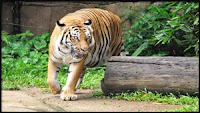
PETALING JAYA: The animal that symbolises Malaysia – the Malayan tiger – has leapt into the 11th Malaysia Plan.
With not more than 350 of this large cat still roaming our forests, the Government plans to increase its numbers along with other endangered species such as the elephant, sambar deer (rusa) and the gaur (seladang).
One such existing initiative that will be intensified is the 1Malaysia Biodiversity Enforcement Operation Network (1MBEON), which aims to curb wildlife poaching. Spearheading the programme are the National Resources and Environment (NRE) Ministry as well as the Defence Ministry.
The NRE’s Department of Wildlife and National Parks director of ex-situ conservation division Fakhrul Hatta Musa revealed that the programme has managed to cripple several poaching syndicates since its inception last year.
“Our aim is to stop poachers from harming protected wildlife,” Fakhrul Hatta said.
Fakhrul Hatta explained that 40 officers from the NRE and 60 army personnel patrol the forest reserves in Malaysia. So far, the programme has conducted five operations, successfully nabbing at least 10 poachers.
Each operation, he said, lasts 18 days with the budget for food, staff allowance and transportation costs setting his department back by RM50,000 each time. “We always need more officers to have more regular patrols,” he said.
So far, 1MBEON has managed to save wildlife with an estimated street value of RM500,000 from being poached.
Source: thestar.com.my
Labels: 1MBEON, Perhilitan, SMalayan Tiger
Eco-viaducts are built to facilitate movements of wildlife, but do they work?
Posted by Unknown on Monday, September 22, 2014| A black giant squirrel utilising a wildlife crossing beneath a viaduct. |
| Banded leaf monkeys photographed under a viaduct – Gopalasamy Reuben Clements |
Between 2011 and 2013, he monitored animal movements through camera traps at 10 viaducts each at the Aring-Tasik Kenyir road in Terengganu and at the Gerik-Kupang road which traverses the Bintang Hijau Range in Perak and Kedah. (Only three of the viaducts were specifically built for animal crossings; the rest are normal viaducts which can also function as such because of the passageway underneath.)
Gopalasamy found the animal crossings being used by almost half the mammal species recorded in nearby forests.
“However, this does not mean that the viaducts are effective crossing structures because some species were recorded just once under the viaduct during our entire study. Also, the same number of species may be crossing the road without the viaduct,” says the associate professor at Kenyir Research Institute in Universiti Malaysia Terengganu. Read more
Source: thestar.com.my
Some interesting facts about World Tapir Day -
World Tapir Day has been established since 2008, to raise awareness about the four species of tapir that inhabit Central and South America and South-East Asia. Each of the four species is in decline and is threatened by human activity such as mining, deforestation, farming and hunting.
Tapirs play an important role in their ecosystems and are one of the oldest surviving genera in the animal kingdom, but despite their size, history and ecological importance, tapirs remain one of the least recognised species of animals. In comparison with other animals, tapirs feature little in the collective consciousness and are frequently misidentified by zoo visitors. Even in their home ranges, tapirs receive little attention, with exotic species featuring more prominently in zoos, children's books and the media.
The plight of tapirs is symbolic for the wider threat to their habitats specifically, and the world's ecology in general. The decline of tapir populations is indicative of the general health of their ranges - their disappearance from their home ranges often marks a point of 'no return' for the natural environment. The destruction of forests into small, isolated enclaves and the encroachment of human activity into pristine forests affects all native species. However, as the largest - yet one of the most secretive - of animals in their ranges, tapirs' disappearance is often not noticed until it is too late.
All tapirs are endangered species. Saving tapirs helps to save the rainforest. Saving rainforests helps to save the planet.
Sources: tapirday.org
Did you know that 'World Tapir Day' falls on the 27th of April every year?
Do you know what a tapir is? What does it look like?
Labels: Malayan tapir, Perhilitan, Tapir
Perhilitan: Severe penalties await wildlife poachers and traders
Posted by Unknown on Friday, June 8, 2012
TEMERLOH: Wildlife poachers and traders of protected animals face severe penalties, including jail and a fine or whipping, upon conviction.
Pahang National Parks and Wildlife Department (Perhilitan) director Khairiah Mohd Sharif said monkeys and pangolins were protected animals, and it was an offence to catch and sell them.
She was responding to claims by several local people, including orang asli, that they were influenced by wildlife trafficking syndicates on the Internet.
Khairiah said she was disappointed that some people had allowed themselves to be manipulated to make money through illegal means.
“There are many ways to earn money, but not by hunting or trading in protected animals,” she said yesterday.
On another matter, Khairiah said the department would not be issuing any licence to keep the leopard cat, hill myna and hanging parrot.
She said anyone caught hunting and keeping the protected animals could be penalised under the Wildlife Conservation Act 2010. - Bernama
![]() |
| Kelantan Wildlife and National Parks Department assistant officer Cosmas
Ngau (right) and colleague Mohamad Daud with some of the pangolins
seized from smugglers near the border. Pic by Adnan Mohamad |
KOTA BARU: STATE police prevented 171 pangolins worth RM340,000 from
ending up in cooking pots in Thailand with the arrest of five men on
Saturday.
The men, aged between 30 and 45, were detained in two operations in Jeli and Bachok. Police said in Jeli, they detained two men at a roadblock near the Mara
Junior Science College at 4am and seized 16 pangolins from them. They also seized the four-wheel-drive vehicle the duo were in.
Some 20 hours later, another police team in Bachok seized 155 pangolins
packed into nets from three men while they were at an unnumbered house
in Kampung Alur Tok Majan. Another 4WD vehicle was also seized here. The pangolins (manis javanica) and the five local men were later handed
over to the state Wildlife and National Parks Department.
Department assistant officer Cosmas Ngau said the pangolins were
believed to have been brought into Kelantan from other states several
hours before they were seized. "We believe the pangolins were being smuggled to Thailand separately through Bukit Kayu Hitam in Kedah and Rantau Panjang."
Ngau said pangolin flesh, popular as a delicacy and for its perceived
"health benefits" could fetch up to RM350 and RM380 per kg on the black
market. He said the seizure in Bachok was the biggest over the past five years. "One of the pangolins seized in Bachok is also the biggest seized by us so far. The male pangolin weighed 10kg."
The rare ant-eating animal feeds a mainly Asian market, where pangolins
are eaten as delicacies and their scales sought after for various
remedies. Pangolin scales are made chiefly of keratin, a substance believed to
have curative value in traditional Asian medicine despite scientific
evidence to the contrary.
The latest major attempt to smuggle wildlife out of the country was reported in The Star. Forty-six pangolins hidden inside a car booth were discovered by the Kedah Department of Wildlife and National Parks (Perhilitan). The pangolins worth RM43,000 were meant for export.
It has in the past been reported that other animals like the
Malaysian tiger, the honey bear and various species of monkeys were
poached for their body parts. However what we are facing today is not
small time poaching but extensive wildlife trafficking, an illicit
business running into billions of ringgit.
Over the years Perhilitan has been endeavouring to stamp out this
menace without much success. The Law and Enforcement Division of
Perhilitan has had more stringent laws passed and sentences increased
for convicted wildlife smugglers but this does not seem to have deterred
them.
In the second half of 2011 alone a consignment of 664 elephant tusks
with a value of RM2.3 million was uncovered in Penang. Two weeks later
an even bigger transhipment from Tanzania meant for China consisting of
695 elephant tusks worth RM3 million was uncovered at Port Klang. It appears Malaysia is is not only gaining adverse publicity with its
illegal wildlife trade but is unintentionally on its way to becoming a
hub for international wildlife smuggling.
According to Bernama, experts have estimated that the global wildlife
trade is US20 billion (RM60 billion) annually, second only to drug
trafficking. Freeland, an organisation “For
a world free of wildlife trafficking and human slavery” believes that
the man on the street can play his part in eliminating this wildlife
debilitating activity by being conscious of and making the following a
part of daily living:
• Report any evidence of wildlife trafficking or sale of protected species you notice or hear about.
• Be an informed consumer by finding out where products come from and what they are made of before you purchase them.
• Keep up to date – follow Freeland on Facebook, Twitter, and YouTube. Subscribe to the Freelander e-magazine.
• Keep your family, friends and community leaders informed about the
scale and impact of the illegal wildlife trade. Get them to take
responsibility too.
The extent of the trade uncovered in Malaysia to date may only be the
tip of the iceberg. Perhilitan and other relevant authorities must
ensure that the laws enacted are enforced to the maximum. ‘Lizard Kings’
must pay in full for their part in enabling this dismal trade to
flourish.
Source: Helen D'Cruz (http://cj.my)
Labels: elephant tusks, Freeland, Perhilitan, Wildlife trafficking
Malaysian Maritime saved 26 pangolins from ending in cooking pots
Posted by Unknown on Tuesday, May 29, 2012![]() |
| Image Source: mmea.gov.my |
![]() |
| Image Source: mmea.gov.my |
Alor Gajah: The Malaysian Maritime Enforcement Agency (MMEA) saved 26 pangolins from ending in cooking pots after detaining two men at the Pulau Hanyut waters here last night.
Kuala Linggi MMEA Capt (Maritime) Abu Bakar Idris said the two men, aged 40 and 41, were in a boat at 8.15pm and tried to escape when spotted by the MMEA vessel that was on patrol in the area.
Abu Bakar said when spotted by the MMEA, the boat sped off to the
Malaysia/Indonesia border towards Banda Hilir but the MMEA vessel
managed to intercept the boat about five nautical miles from Pulau
Hanyut.
"Upon inspecting the boat, we found 26 sacks filled with pangolins
while the duo failed to show any documents for the animals," he told
reporters here today. He added that the suspects may have thrown a
number of sacks into the sea to erase evidence.
Abu Bakar said initial investigations revealed that the pangolins, an
exotic meat here, was worth RM50,000 and smuggled into the country from
Indonesia to be sold in Melaka.
Source: NST
Labels: Alor Gajah, Maritime, MMEA, Pangolin, Pangolin Trafficking, Perhilitan
ALOR STAR: Forty-six pangolins, worth RM43,000, were saved from the cooking pot yesterday. The animals, which were bound for exotic food restaurants in a
neighbouring country, were found in the boot of a Toyota Camry at a
traffic light in Changlun near here at 8.30am. Kedah and Penang Wildlife and National Parks Department (Perhilitan)
officers had trailed the car for about 30km from the Hutan Kampung Toll
Plaza near here.
The car driver pushed the officers away and fled the scene on foot when the Perhilitan team approached his vehicle. State Perhilitan director Rahim Ahmad said four of the pangolins were juveniles. Rahim said he believed that the pangolins were to be supplied to Thailand.
"Prior to the discovery, we conducted an investigation to locate the poacher following a tip-off from the public." Rahim said the department had lodged a report to seek the police's help in locating the suspect.
Pangolins are much sought after as exotic meat and it is believed the consignment was being smuggled to Thailand. Rahim said the pangolins would be released in the forest reserves of Pedu, Padang Terap and Ulu Muda.
Source: NST
RAKING IN THOUSANDS: 'Female customer' helps expose mechanic, suppliers
![]() |
| The Wildlife and National Parks Department succeeded in seizing three leopard cats from an Orang Asli in Kampung Simpai, Pekan |
KUANTAN: FOR more than a year, a 30-year-old mechanic had been managing a website selling exotic pets and raking in thousands of ringgit each month from his customers through the Internet.
His online activities came to an end last week, however, when a female customer who called and enquired about the exotic birds on his website exposed his illegal business to the state Wildlife and National Parks Department (Perhilitan).
He was arrested on May 23 and the following day, the suspect led the enforcement team to one of his suppliers at an unnumbered house in Kampung Simpai Orang Asli settlement in Pekan. There, the team seized three leopard cats (kucing batu), 15 blue-crowned hanging parrots (burung serindit) and two hill mynahs (burung tiong mas).
The 51-year-old supplier, who owns an oil palm plantation at the settlement, kept the endangered species in several cages near his house and initial investigations revealed that he had been actively poaching and selling them to the middleman. Sources revealed that Perhilitan had been monitoring the website operator's activities and modus operandi for several months before laying the trap and managed to nab the suspect last week.
"He would post the photographs of the exotic pets on the website and would only deal through the phone. Customers were required to transfer the amount which had been discussed to a bank account number. "Upon receiving the payment, someone would deliver the animal to the respective buyer. We believe the suspect operates a syndicate and we are tracking down the other members," said a source.
Investigations revealed that the website operator purchased the leopard cats for RM250 each, parrots between RM80 and RM100 each, and hill mynah's at RM15 each before selling them at RM1,500, RM600 and RM50, respectively.
State Perhilitan director Khairiah Mohd Shariff said the department was in the midst of identifying the other suppliers, believed to be Orang Asli at nearby settlements who have been providing endangered animals to the syndicate. She said Perhilitan had recorded statements from both the suspects before releasing them on bail.
Source: NST
Source: NST
![]() |
NINETY-FOUR pangolins believed to be bound for the cooking pots in
the region were seized by the authorities at the cargo complex in Batu
Maung, Penang. The importer had shipped the animals in boxes from Sabah and declared them as crabs.
However,
checks by the Penang Wildlife and National Parks Department
(Perhilitan) and the Malaysian Quarantine and Inspection Services
(Maqis) found that 43 of the 49 boxes contained pangolins. State
Perhilitan director Jamalun Nasir Ibrahim said they were still
investigating where the protected species worth about RM106,000 were
heading. “We believe the animals will be sold in foreign markets where the demand for exotic meat is high. “The price of the pangolin meat can go up to RM220 per kg.
Jamalun said the case was
being investigated under the Wildlife Conservation Act 2010 (Act 716)
and if convicted, the offender would face a fine between RM50,000 and
RM100,000 or a jail term up to three years. In a separate case,
the department’s licensing unit led by officer Rofley Ambuka raided a
petshop in Bukit Mertajam and found 103 turtles not listed in its
registry.
There were 40 Southeast Asian Box Turtles (Cuora
amboinensis), 41 Giant Asian Pond Turtles (Heosemys grandis) and 22
Black Marsh Turtles (siebenrockiella crassicollis) with a total market
price of RM7,000.
Source: thestar.com
Labels: crabs, maqis, Pangolin Trafficking, pangolins, Perhilitan, perhilitan penang, smuggle
GEORGE TOWN - A shipment declared as papayas was found to contain
hundreds of cobras and freshwater turtles worth some RM110,000
(S$45,000) meant for the cooking pot in Hong Kong.
The animals were rescued by the Department of Wildlife and National
Parks (Perhilitan) in a joint raid with the Malaysian Quarantine and
Inspection Services at the KL Airport Services local cargo complex in
Batu Maung near here.
Penang Perhilitan director Jamalun Nasir Ibrahim said the 555 cobras
and 171 turtles were found inside 80 polystyrene boxes which were kept
among 100 boxes of papayas in a container.
The shipment, he said, was declared as papayas bound for Hong Kong. He said the driver of the lorry transporting the container was arrested during the raid around 4.30am on Wednesday.
"We arrested the driver, who is in his 40s, to facilitate investigations to track down the mastermind," Jamalun said yesterday.
He believed a syndicate was behind the smuggling of the giant Asian
pond turtles (Heosemys grandis) and the monocellate cobra (Naja
kaouthia).
"We believe the animals were to be smuggled out to meet the demand for exotic animal dishes," he added.
Jamalun said the cobras could fetch RM200 each for the bigger ones
and about RM800 each for smaller ones while the turtles cost about RM200
each.
Both species, he said, were listed under the Convention on
International Trade in Endangered Species of Wild Fauna and Flora, which
meant that trading in them was only permitted with an export permit and
certificate of origin.
Based on the shipment's documentation, he said, the papayas were harvested from a farm in Kedah.
Jamalun said the case was being investigated under Section 10 of the
International Trade in Endangered Species Act that carries a fine of not
more than RM100,000 for each animal but not more than RM1mil in
aggregate, or a maximum seven-year jail term or both.
Source: thestar.com
Zoo Melaka with an area of 54 acres (21.2 ha) is situated in Ayer Keroh, which is a well-known tourism destination in Melaka. The zoo was established in 1963 and originally under the Melaka State Government but its management was taken over by The Department of Wildlife and National Parks (DWNP/PERHILITAN) in 1979 and was officially opened to public by the then Prime Minister, Dato Seri Dr. Mahathir Mohamad on 13th August 1987. The zoo which is also a member of the South-East Asian Zoological Park Association (SEAZA). consist of 4 division that is administration, veterinary, curator and zoo development division.


Zoo Melaka has progressed rapidly to be the second biggest zoo in the country. Located approximately 13 km from the city center of Melaka, it was the first zoo in the region to exhibit the endangered Sumatran rhinoceros and Gaur. At present, there are a total of over 1200 specimen made up of 200 species of birds, mammals, reptiles and amphibians in the zoo.
The major attractions of Zoo Melaka are the Malayan Gaur, Serow and the Malayan Tiger. In line with the current zoo development Zoo Melaka adopted an open concept and maintains the natural green environment. Zoo’s Melaka role is as a centre for wildlife research, conservation breeding, zoo education center and a popular tourist destination. In order to achieve its goal, the four major functions Zoo Melaka are as follows:
Captive Breeding
Zoo Melaka functions as the major ex-situ breeding center for the DWNP. In this programme, breeding stock, especially the local threatened species are sourced for breeding in the zoo. Species successfully bred includes tiger, panther, tapir, serow, barking deer, sambar deer and many others.
Research
Research
Research works carried out emphasized on medical research/treatment and behavioural studies. Zoo Melaka also provides support for researchers from DWNP and other institutions of higher learning.
Recreation
Zoo Melaka provides affordable recreation opportunities. Promotions were carried out to attract more visitors and hence generating more revenue to the government and contributing toward the development of national tourism industry.
Education
The programme is designed to create awareness to the general public on wildlife and its conservation. Among the activities are lectures, video shows, publication of printed material and signage posted at all exhibits in the zoo.
Activities
Multi-animal show
Photography session with Orang Utan, birds and snake after show
Elephant Show
Photography session with elephant after show
Elephant feeding
Elephant and Horse rides
Every weekend, public holiday and school holiday
Tram Service
Visiting Hour
Day Zoo
Time : 9.00 am - 6.00 pm
Day : Monday - Friday
Night Zoo
Time : 8.00 pm - 10.00 pm
Day : Saturday, Sunday, School Holiday and Public Holiday
Entrance Fee :
Day Zoo
Adult (13 years and above)
Normal price - RM 7.00
Package price - RM 5.00
Children (5-12 years old)
Normal price - RM 4.00
Package price - RM 2.00
Student with uniform
Normal price - RM 2.00
Package price - RM 2.00
Video Camera
Normal price - RM 10.00
Package price - RM 10.00
Night Zoo
Adult (13 years old and above)
Normal price - RM 10.00
Package price - RM 8.00
Children (5-12 years old)
Normal price - RM 5.00
Package price - RM 4.00
Note : Camera, video camera and torchlight are not allowed for the Night Zoo.
Sponsor
The Zoo Melaka Adoption Scheme provides opportunity for individuals, private companies and corporate bodies to sponsor wildlife species in the zoo. The sponsorship will help support the cost of maintaining the animals. All sponsorship will be deposited into the Zoo Melaka Trust Fund which is managed by the zoo. Proceed from this trust fund will be used to pay for additional food for the animals, medicine, enclosure improvement and modification.
Privilege Afforded To Sponsors:
| |
i.
|
Free admission and the number of tickets depend on the amount of sponsorship.
|
ii.
|
Signboard of sponsorship will be erected at the animal enclosure for sponsors above RM 1,000.00. The sponsors will be allowed to include their logo on the signboard.
|
iii.
|
Sponsors will be allowed to conduct separate promotional programmes, which benefits both parties.
|
iv.
|
Sponsors will be allowed to organize their own activities such as Family Day in specific areas in the zoo.
|
v.
|
Sponsors will enjoy free publicity apart from the cheque presentation ceremony. These include World Children Day, press releases on new animals born in the zoo and other occasions, which the zoo organizes.
|
vi.
|
A certificate of appreciation will be presented to sponsors contributing more than RM 1,000.00
|
vii.
|
The Director of company sponsoring the animal adoption scheme will be invited to present the sponsorship cheque to the Chief Minister of Melaka in a special ceremony.
|
viii.
|
All sponsorship to the Zoo's Adoption scheme will be tax exempted under Section 44(6) Akta Cukai Pendapatan 1967.
|
ix.
|
Sponsors pledging more than RM 10,000 will be allowed to erect their own signboards.
|
For more information, please contact:
Hang Tuah Jaya, 75450 Ayer Keroh, Melaka.
Tel: 606-232 4054
Fax: 606-232 5859
E-mail: zoomelaka@wildlife.gov.my
Director
Zoo MelakaHang Tuah Jaya, 75450 Ayer Keroh, Melaka.
Tel: 606-232 4054
Fax: 606-232 5859
E-mail: zoomelaka@wildlife.gov.my
KUALA LUMPUR: A casual observer would be none the wiser seeing a tricked-out luxury car speeding down the highway. That is exactly what traffickers hope for as they transport their illicit cargo of endangered wildlife. Perhilitan, the Wildlife Protection and National Parks Department, said it had come across quite a number of cases of Malaysian-registered luxury cars being modified to hide the animals. “Transporting the animals using lorries is the more obvious choice while luxury cars don't usually arouse suspicion,” a Perhilitan spokesman said.
Traffickers are also getting smarter, switching modes of transport where it is least expected. The spokesman said the department had encountered cases where the luxury cars were driven from Johor to Kuantan in Pahang for the precious cargo to be transferred to a ship to be taken out of the country. Another tactic is to hide illegal wildlife by mixing them with products such as fish and vegetables while some traffickers try to pass off the animals as airline cargo, the spokesman said.
He said enforcement activities to stop animal smuggling are being hampered by information leaks, with “tontos” people working for syndicates monitoring the movement of Perhilitan officers. “We also have to deal with false tip-offs, getting information that is inaccurate and outdated,” said the spokesman, adding that the department urgently needed more enforcement officers. “We have forwarded the request for more staff to the Natural Resources and Environment Ministry.
“In the meantime, we have to ensure our staff are trained to deal with international wildlife crime, with the help of the police, Customs Department, the Anti-Smuggling Unit and the Malaysian Maritime Enforcement Agency,” he said. To break the multi-million ringgit cycle of illegal wildlife trade, the Government is hitting smugglers where it hurts. The Wildlife Conservation Act 2010 spelled the end of token fines and slaps on the wrist for convicted wildlife traffickers.
Offenders now face fines of up to RM500,000 and mandatory jail time. The highest penalty imposed on a wildlife offender by the courts to date is a RM200,000 fine and one-day jail on an individual in Penang for possessing 135 pangolins in Feb 23 last year. From the time the Act took effect, the country saw a drastic drop in wildlife smuggling cases from about 3,500 cases a year from 2007 to 2010 to just 464 in 2011.
While the sharp dip is proof that the heavy penalties under the new Act, coupled with intensified multi-agency operations, are working, the Perhilitan spokesman said the department has to be on its toes to keep up with the increasingly sophisticated methods used by the traffickers.
Source: thestar.com.my
Labels: Luxury car, Pangolin Trafficking, pangolins, Perhilitan, smuggling
A new regulation spells hope for the betterment of animals kept in zoos.
IF
animals could laugh and sing in happiness, there would be some
trumpeting of joy emerging from zoos and wildlife parks in Peninsular
Malaysia for on Feb 1, the Wildlife Conservation (Operation of Zoo)
Regulations 2012 was gazetted.
The new regulation gives voice to
the need to regulate zoos systematically and to higher standards. Animal
lovers and conservationists have long highlighted the terrible
conditions under which wildlife is held in captivity in such
establishments. The problem was also widely highlighted in the media
last year.
The new regulation is made possible with the
enforcement of the Wildlife Conservation Act 2010 in December 2010. It
replaces the Protection of Wildlife Act 1972 which had been criticised
as lacking bite and failing to address many concerns.
![]() |
| Contrasting habitats: At Taiping Zoo, the orang utan enclosure has a good soft substrate and enrichment equipment, such as climbing vines. |
One of the failures was the lack of power for the Department of
Wildlife and National Parks (Perhilitan) to act against errant zoos and
wildlife parks. Also, the old legislation has no provisions addressing
wildlife welfare and cruelty to captive animals. The new regulation
resolves these loophole as it provides for some areas where Perhilitan
could take action against errant zoos.
Zoo operators have a
six-month grace period to comply with the new requirements of the
regulation. Those which do will be issued an annual permit. Any person
operating a zoo without a permit is liable to a fine not exceeding
RM70,000 or/and a prison term not exceeding three years.
The new regulation requires zoos and animal parks to:
> Adhere to minimum cage sizes, which are specified according to various animal groups.
> Have a quarantine area and a veterinary clinic or hospital.
> Employ a full-time consultant veterinarian.
> Provide vaccination of animals by a veterinarian or anyone under his supervision.
> Provide nutritious and sufficient food for the animals, as prescribed by a veterinarian.
> Maintain a record of kept animals and their health care.
> Ensure the cleanliness of the facility.
> Conduct euthanasia of wildlife whenever necessary.
> Conduct wildlife shows that involves the animals’ natural behaviours only.
> Submit a deposit to Perhilitan for the upkeep of animals should they be seized.
Operators
who contravene these provisions are liable to a fine not exceeding
RM100,000 or/and a prison term not exceeding five years.
Singapore-based
non-governmental organisation Animal Concerns Research and Education
Society (Acres), which has done several surveys of Malaysian zoos and
pointed out the weaknesses of these establishments, views the new
regulation positively.
“It is undoubtedly a good start and it
shows that Perhilitan is serious about addressing zoo animal welfare
issues and has also responded positively to the feedback given by Acres,
other non-governmental organisations (NGOs) and members of the public.
This is undoubtedly one of the best zoo regulations we have seen in
South-East Asia,” says executive director Louis Ng.
Upreshpal
Singh, founder of the Friends of Orang Utans Malaysia, concurs. “The new
law looks really good and it comes at a time when many zoos still have
to improve, some more so,” he says.
While acknowledging that the new regulation is “a good start”,
Sahabat Alam Malaysia (SAM) president S.M. Mohamed Idris questions if
Perhilitan has the manpower to inspect the many operations that house
wild animals. “The new legislation cannot be effective until enforcement
officers have acquired expertise in recognising defects in animal
husbandry and can devote their time to unannounced physical checks of
premises,” he says.
The Natural Resources and Environment
Ministry (NRE), however, assures that there will be enough manpower to
scrutinise the zoos as it will rely on Perhilitan’s zoo audit team, law
enforcement team and wildlife crime units, as well as its own
independent zoo review panel. In response to concerns raised by Traffic
South-East Asia senior communications officer Elizabeth John, it says
the operating permit of a zoo will not be automatically renewed each
year. An audit would be done first to ensure compliance with the
regulation. In addition, Perhilitan will conduct enforcement checks,
attend to public complaints and provide advice to the zoos.
Too lenient
Sean
Whyte, founder of Britain’s Nature Alert and a strong critic of
Malaysian zoos, describes the regulation as “comprehensive and
excellent”. However, he worries about Perhilitan’s dismal record in
enforcing the law and the leniency which it has shown to some zoos. “The
new law will be useless if not enforced diligently and transparently by
Perhilitan. We can only judge them by what they do, not by what they
say they will do,” cautions Whyte.
The Ministry counters that NGOs, instead of making accusations, should join Perhilitan in its Teman Zoo Program (Friends of Zoos Programme), an outreach programme launched in July last year for guidance to zoo operators.
“The
NGOs can file their complaints to various government agencies, media
and political parties if they feel Perhilitan has committed any wrong
doings,” it adds.
Measures to monitor the diet of captive animals
and their health records are addressed in the Zoo Best Management
Guidelines which are now being drafted. On the NGOs’ criticism that the
regulation is silent on the type of substrate and furniture used in
animal enclosures, the Ministry says these will be controlled by
Perhilitan’s zoo audit team and the NRE zoo review panel.
The
Ministry says animal inventory – data on births, deaths, acquisitions,
escapes, transfers and releases – will be governed by the main Act,
specifically in the provisions on “licences and permits”, and also under
“duties and obligations”.
“The animal’s record must tally with
the tag ID which must be reported to the licensing division for
verification when acquiring the animal,” says the Ministry.
But a perusal of the main Act sees some ambiguity in matters concerning animal births, escape and release.
Purely entertainment
One
contentious issue with regards to wildlife park operations is the
running of animal shows to entertain visitors. Among the acts which had
wildlife lovers fuming were: a sun bear made to support itself on a
rolling drum; a pig-tailed macaque on a leash made to dive into a tank
of water from a raised platform; and orang utans made to cycle.
Previously,
zoos have been issued “instructions” to conduct shows which only
exhibit the natural behaviour of animals but this was openly flouted.
The instruction is now provided for under the regulation.
The
Ministry says if zoos fail to comply with the new requirement after the
six-month grace period, action will be taken. “The public, too, must do
their part by not demanding for circus acts and shy away from it.
Awareness is pertinent in this aspect,” it says. To ensure the welfare
of captive animals, matters pertaining to cruelty and mistreatment are
covered in the main Act.
![]() |
| Do it right: Will our zoos look like this in future? This lush enclosure at Singapore Zoo provides a semi-wild environment for a captive tiger. |
Meanwhile, three other regulations are
being drafted to address other concerns. The proposed Wildlife
Conservation (Disposal) Regulations will stipulate matters on euthanasia
of animals and require records of disposals to be reported to
Perhilitan’s licensing division. The proposed Wildlife Conservation
(Commercial Captive Breeding) Regulations will regulate breeding and
surplus zoo animals. Transportation of animals to and from zoos will be
covered under the proposed Wildlife Conservation (Exhibition) Regulations.
Meanwhile,
SAM asks that all proposed new zoos and parks – such as the purportedly
largest bird park in South-East Asia, to be sited at the Botanical
Gardens in Ayer Keroh, Malacca; the zoo in Kemaman, Terengganu; and the
Bukit Gambang Safari Park in Kuantan – be put on hold. It says getting
existing zoos to meet the new standards should be the priority for
Perhilitan.
The department, however, sees no reason why the new
zoos should not be set up as long as they are in accordance with the new
regulation. Well, it remains to be seen how effective the policing of
the new law will be. Meanwhile, those concerned with the treatment of
animals in zoos say they will be vigilant.
Source : thestar.com.my
![]() |
| Sugar Glider courtesy of Pxleyes.com |
Malaysia will tighten controls on the trade in sugar gliders, a big-eyed gliding possum increasingly popular in the pet trade in Southeast Asia and the United States, according to the country's Department of Wildlife and National Parks (Perhilitan).
As reported by TRAFFIC, Perhilitan’s Deputy Director Zaaba Zainol Abidin said his agency will move to protect sugar gliders under Malaysia's Wildlife Conservation Act. Currently sugar gliders are subject to quotas in Malaysia, but the 225 annual harvest limit appears to be grossly exceeded.
TRAFFIC, the wildlife trade monitoring network, applauded the announcement.
"TRAFFIC welcomes this proactive move by Perhilitan to control the trade in Sugar Gliders," said Chris R. Shepherd, Deputy Regional Director of TRAFFIC Southeast Asia, in a statement.
"We support these efforts to provide better protection against illegal wildlife trade, which in many countries appears to continue with little interruption from the authorities. Current levels of trade in wild-caught Sugar Gliders not only indicate that quotas are being ignored, but also suggest trade may potentially be a serious threat to this species."
Sugar gliders, a type of marsupial, live in the rainforests of eastern Indonesia, Papua New Guinea, and Australia. Most animals available in the pet trade in Malaysia are trafficked from Indonesia. Only a small number are believed to originate from captive breeding facilities in Indonesia.
Source: mongabay.com
Labels: Perhilitan, sugar gliders, TRAFFIC
A research project looks at whether wildlife crossings work.
Source: myrimba.org
THE forest reserves around Tasik Kenyir in Terengganu teem with
wildlife. Aside from the 230 bird species which the area is known to
harbour, research group Rimba in recent surveys has recorded at least 19
mammal species in the area.
Their camera traps have captured
stunning images of various rare and endangered species. In one picture, a
female Asian elephant and her calf, their eyes shining in the flash of
the camera, are seen making their way through leaf litter. In other
images, tigers, sun bears, clouded leopards, tapirs and serows make up
more of the jungle milieu.
For most of these animals, a large
expanse of habitat is crucial for populations to remain viable in the
long term. But their habitats are being cut up by advancing development.
In addition to being a barrier for animals to reach resources such as
food, shelter and mates, isolated and fragmented habitats pose a threat
to the healthy mixing of populations. A genetically diverse pool of
individuals is needed to avoid the negative effects of inbreeding and
reduced genetic diversity.
Unfortunately habitat fragmentation is a problem in Malaysia, albeit
one that has, to an extent, been addressed by the Central Forest Spine
(CFS). Part of the National Physical Plan, the CFS is a masterplan which
delineates a network of forest complexes connected by ecological
linkages (corridors of forested land) to create a contiguous forest
running the length of Peninsular Malaysia.
The forests around
Tasik Kenyir, including the Hulu Temelong, Petuang and Tembat forest
reserves (in which Rimba researchers are surveying a 140sqkm stretch),
make up one such linkage. Known as Primary Linkage 7, this green
corridor links Taman Negara to forests in the north. The area is one of
three priority areas in the National Tiger Action Plan, a blueprint
document on the conservation of the big cat.
The reserves are
bisected by the Kuala Berang highway, which forms a dangerous barrier
for migrating wildlife. Intrusions such as this into the sanctity of our
wilderness are by no means unique and are a regular occurrence
worldwide.
![]() |
| Come this way: An ‘eco-bridge’ at Sungai Kembur along the Simpang Pulai-Kuala Berang road enables animals to cross between forests fragmented by the highway. |
Safe crossings
The trend of building
wildlife crossing structures began in the 1950s and is today a common
strategy deployed in many countries. Some of the most recognisable
structures were built in the 1970s in Banff National Park in Alberta,
Canada, where 24 vegetated overpasses provide safe passage over the
Trans-Canada Highway for bears, moose, wolves and many other species.
Crossings don’t have to pass over obstacles, however. In the
Netherlands, over 600 tunnels have been installed under major and minor
roads to aid in movements of the endangered European badger.
In
Malaysia, the Kuala Berang highway features 10 viaducts which offer
traffic-free crossing points for wildlife. Viaducts are elevated road
structures, typically passing over a valley or lower ground, and
supported by arches or columns. Three of these viaducts were built
specifically as wildlife crossing points, and have been termed
“eco-viaducts”. Unlike the vegetated overpasses in Alberta, safe passage
for wildlife in our viaducts lies with passing under the structure.
The
construction of eco-viaducts in Malaysia has been championed by
environmentalists as a promising measure but there have as yet been no
studies to confirm their effectiveness in the tropical context. The task
of verifying their usefulness is a huge undertaking and requires many
months of survey and data collection through thick forest, followed by
months of data analysis.
Nonetheless, having science to verify
the effectiveness of well-intentioned policy is important to ensure the
best solutions for protecting Malaysia’s valuable stocks of
biodiversity. That is precisely the thinking behind Rimba, a coalition
of local and foreign scientists, which has embarked on a project to
monitor the use of wildlife crossings along the Kuala Berang highway.
Country-specific solutions
The combination of wildlife
crossings and roadside fencing has been found to be helpful for some
species. Rimba’s Kenyir Wildlife Corridor Project lead researcher
Gopalasamy Reuben Clements, 32, says that in Malaysia, the Wildlife and
National Parks Department (Perhilitan) had previously tried to funnel
animals underneath viaducts through the construction of electric fences.
But
what works for wildlife crossings in other countries might not be
appropriate for Malaysia. One consideration is a difference in local
fauna. Elephants, for example, are known to have fixed migration routes;
they broke through the fencing.
Another important factor is
rampant illegal trade in wildlife. The country’s excellent
infrastructure and road networks, many of which bypass forest reserves,
not only open up access to wildlife poachers but offer convenient routes
for a speedy onward journey.
“So far, NGOs have been
recommending the building of viaducts but the poaching element hasn’t
been looked at,” Clements points out. The conservation biologist hopes
his study will determine whether animals at such wildlife crossings
might in fact, be more vulnerable to poachers.
The Kenyir
Wildlife Corridor Project is part of his PhD research with James Cook
University in Queensland, Australia. A Singaporean and Master’s graduate
from the National University of Singapore, Clements is also a research
associate with Universiti Malaya and previously worked at World Wide
Fund For Nature Malaysia on tiger and rhinoceros conservation projects.
![]() |
| When roads cut through wild areas, animals can end up as roadkill. |
In total, Clements and his team have installed 80 camera traps – 40
within forest reserves on either side of the highway, and the rest, in
and around the viaducts. They have covered 140sqkm of jungle, trekking
some 8km a day and roughing it out in the jungle, to look for signs of
wildlife and rotate cameras around the study grid to get a more
representative data.
Covering the entire area took them three
months, and they still have two more rounds of sampling to go before
it’s time to analyse the data. Nevertheless, the team has already been
able to glean some insights.
For example, they noticed one
particular tiger, recognisable by its stripes, was captured by cameras
located both north and south of the highway, but not at ones placed near
or under any of the viaducts.
“That shows it didn’t use the
viaduct. So for large mammals, these viaducts may not be so useful. But
as you can see, you have tapirs and other animals to consider, too. And
we don’t know whether the tiger will use the viaduct in the period
between now and the end of the study, so it’s just preliminary.”
Part
of the project’s mission is to identify potential access routes for
encroachment. This they found – near, under and along the viaduct access
road. They also found old camps in sheltered areas underneath the
viaducts, and cameras have captured images of people carrying fishing
rods. Such evidence of human presence is not seen at three of the newer
viaducts. Clements hypothesises that these are probably too remote.
The
study should reveal if wildlife are actually utilising the structures
and if so, which ones. But what do we do if the eco-viaducts prove to be
less effective than hoped? That, according to Clements, does not mean
the structures lose their usefulness. It might call for a tweak in
strategies – such as more wildlife patrols – to increase their
effectiveness.
By seeing how other factors determine the
effectiveness of eco-viaducts, future crossings can be planned
accordingly. Potential factors, says Clements, could be the distance
between the viaducts and human settlements, the quality of forests on
the other side of the road barrier, and physical features such as
reduced vegetation under the viaduct or reduced food resources due to
the presence of large adjacent water bodies.
Adoption programme
The
Rimba project is a mammoth undertaking requiring expensive technology
(the cameras, password-protected and possessing inbuilt lens, cost
RM1,500 each) and manpower (to conduct surveys and handle the cameras).
Clements has 80 camera traps in action right now but needs 150. With
more cameras, his team can do more accurate population estimates.
So
far, funds have come from grant disbursing organisations, including the
two universities Clements is attached with, and private donors. These
are enough to pay for the 80 cameras and five field assistants.
Rimba
also needs funds for 10 satellite collars for a project on the
management and ecology of Malaysian elephants, to be led by Ahimsa
Campos-Arceiz, an assistant professor with the University of Nottingham
(Malaysia campus). At RM13,000 each, the collars will show the movement
patterns of each animal, thus providing insight into how they cross
roads and use viaducts.
Companies, organisations, societies,
schools and individuals can support the work of Rimba by adopting a
camera, satellite collar or ranger.
> Camera trap
(RM1,500) – You will get a certificate, the opportunity to personally
place your camera trap in the forest, and get e-mail updates of captured
images every three months.
> Satellite collar
(RM13,000) – You will get updates of the collared animal every three
months, a half-yearly progress report and a three day-two night stay at
Rimba Field House.
> Ranger (RM18,000) – You will get a
certificate, an opportunity to place three camera traps in the forest,
receive e-mail updates on these traps every three months as well as a
half-yearly progress report, and a three day-two night stay at Rimba
Field House plus an opportunity to accompany the ranger on field
surveys.
Clements believes that creating a bridge between
researchers and the public as well as providing people with
opportunities to get involved in conservation projects can make a
difference. Research is important – it helps indirectly by knowledge
creation, and deters illegal poachers by the mere presence of
researchers in the forest. On that note, it is a cause worth supporting.
Source: myrimba.org
Labels: eco-bridge, Perhilitan, viaducts, wildlife crossings
Subscribe to:
Posts (Atom)