Outrage of animal welfare groups over Japanese pet shop that insists on selling exotic animals

on Thursday, June 28, 2012


Animal charities have condemned a pet shop in Japan which continues to sell exotic animals - and keep them in tiny cages. Shoppers can easily pick up a penguin, a meerkat and an alligator at NOAH: The Inner City Zoo, in the port of Yokohama. The shop is also seen selling otters, megabats, sloths, fennec foxes, capuchin monkeys and a crane - alongside several other foreign animals.
Behind bars: A capuchin monkey was seen in the shop in the port of Yokohama, Japan, with otters, megabats, sloths and fennec foxes - alongside several other foreign animals
Two alligators are among the animals that all live in one squashed room, on the second floor of an office building
Pick up a penguin: Two penguins are among the exotic animals for sale at Noah in the Inner City Zoo in Yokohama, Japan
Many are endangered species and live in cramped cages - all in one squashed room - on the second floor of an office building. Some of the animals cost thousands of pounds to buy. Josey Sharrad, head of campaigns and communications at IFAW, the International Fund for Animal Welfare, said: 'IFAW absolutely condemn the treatment of these animals.
 More...
'This shop will never be confused with the natural habitat of a penguin, meerkat, sloth, alligator or other exotic pet. 'Animals have needs in terms of diet, space, exercise and sociability. The idea that these are being met in cramped conditions, in an urban environment, and in close proximity to other animals is ridiculous. 'These conditions cause severe stress for the animals. This can weaken immune systems and lead to risk of disease.
An owl for sale at Noah in the Inner City Zoo in Yokohama, Japan
For sale: A meerkat at Noah in the Inner City Zoo in Yokohama, Japan
Inhumane: Animal charities have condemned the pet shop for selling the exotic animals, like this serval
Shop owner Kenji Takahashi insists that the shop meets all Japanese laws, and wants to allow people to understand and experience these amazing creatures. This is a penguin
'These diseases could spread from one species to the other and could also represent a risk to human health. 'It is already a hard task to alert people to the dangers that are faced by some of the world's rarest creatures. 'When these creatures are simultaneously available for purchase, it confuses people as to whether an animal is really at risk of extinction or not.'
Customers have to pay an entry fee of £4 to look around the shop
Josey Sharrad, head of campaigns and communications at IFAW, the International Fund for Animal Welfare, said: 'IFAW absolutely condemn the treatment of these animals.'

A Patagonian Mara for sale: One onlooker said: 'I was shocked to see so many endangered animals for sale'
According to their website, NOAH has just recently taken stock of marmosets, fennecs and squirrels - all as babies. Prices are often on request, and at the time of taking the pictures, a prairie dog - a type of rodent - was priced at £1,500. Alan Knight, chief executive of International Animal Rescue, said: 'We would urge people to stay away from this pet shop and others like it.
Cramped: An inside view of Noah at the Inner City Zoo, in Yokohama, Japan
'Exotic animals should live in the wild as nature intended, not in captivity as a source of entertainment and prestige, and to line the pockets of greedy pet shop owners. 'Breeding and selling wild animals as exotic pets is cruel and irresponsible. 'Wild animals of any species lead miserable lives as the pets of people who have little or no knowledge of how to care for them properly.
The IFAW said the conditions cause severe stress for the animals and can weaken immune systems and lead to risk of disease
'Undoubtedly many of them are eventually abandoned when they become ill or grow too large and too strong for their owners to manage. 'It is particularly shocking to be breeding and selling endangered species because this puts a price on the animals' heads - and encourages people to want them as pets. 'As a result, in many cases exotic animals are caught from the wild - endangering the population as a whole.' NOAH, which stands for Nature Orientated Animal House, was established in 1999. Customers have to pay an entry fee of £4 to look around the shop.

One onlooker said: 'I was shocked to see so many endangered animals for sale. Particularly the penguins and crane - who would want those as a pet anyway? 'Most animals were quiet, as if they'd come to terms with their enforced captivity. Many are in tiny cages, and the owls are tightly fixed down so they can't fly. 'On occasion, a monkey would throw a noisy fit in its cage, and run around screaming, trying to escape. The animals looked sad.' 

Owner, Kenji Takahashi, 59, insists that he obeys all the rules of Japan. 'I may not agree with all the laws of Japan, but I must obey them,' he said. 'My premises may not be perfect and the space we have for each animal is not as big as we would sometimes like. 'But the same could be said for any zoo across the world. What I am trying to do is increase the love that humans have for exotic animals.

'If you keep tropical fish you are less likely to throw a cigarette in a river because you know how important the water quality is to the creatures that live there. 'I want to allow people to understand and experience these amazing creatures.' 

Our Media: 1 Million to Ban the Lion Trade Sign petition


Hundreds of South African lions are being slaughtered to make bogus sex potions for men. But we can stop this cruel trade by hitting the government where it hurts -- the tourism industry.

A global ban on tiger bone sales has traders hunting a new prize -- the majestic lions. Lions are farmed under appalling conditions in South Africa for "canned hunting", where rich tourists pay thousands to shoot them through fences. Now experts say lion bones from these killing farms are being exported to phony 'medicine' makers in Asia for record profits. Trade is exploding and experts fear that as prices rise, even wild lions -- with only 20,000 left in Africa -- will come under poaching attack.  Read More : secure.avaaz.org

CSI: The Wild - reporting on illegal wildlife trafficking - Environment - Scotsman.com

on Wednesday, June 27, 2012

The endangered Sumatran rhinoceros. Picture: AP
THE illegal trafficking of wildlife is driving some species to near extinction. Now a team based at Edinburgh Zoo is using forensics straight out of a top US crime drama to help halt the sickening trade.

At the heart of Edinburgh Zoo, not far from the rhino enclosure, sits a gleaming white lab that could have come straight from one of the CSI: Crime Scene Investigation TV shows. Like its fictional counterpart, it contains equipment for DNA profiling and sequencing and its elite scientists are at the heart of the fight against crime. But the victims Dr Rob Ogden and his colleague Dr Ross McEwing are faced with are not human, they are animals, and the $20bn global racket they are trying to halt involves the trafficking not of arms or drugs, but wildlife.

So lucrative is the market for exotic animals, and so low the risk of being caught, that some species are being driven to near extinction. Some animals, predominantly birds and reptiles, are being sold as pets. Others are being slaughtered for meat or body parts, which are used in pills or potions.
The pangolin, a scaly anteater whose meat is used for soup, and whose scales are believed to have medicinal properties, is being shipped out of south-east Asia by the crateload, and has been all but wiped out in Vietnam and Cambodia.

The WildGenes lab, where Ogden and McEwing are based, was built 18 months ago for conservation work at the zoo and beyond. When working for WildGenes, the pair, along with their colleague Dr Helen Senn, are involved in using DNA to monitor and influence breeding programmes, and in larger projects, such as the initiative to reintroduce beavers to Scotland.
Prior to its founding, the scientists were already directors of Trace, a non-governmental organisation which brings together forensic experts and enforcement agencies in an attempt to crack down on the trafficking of wildlife. In particular, they have spearheaded the ASEAN-WEN (Association of Southeast Asian Nations – Wildlife Enforcement Network) project, which aims to help countries in Southeast Asia tackle the illegal wildlife trade. Read more : scotsman.com

Endangered Sumatran Rhino Gives Birth in Indonesia

on Sunday, June 24, 2012

Jakarta - A critically endangered Sumatran rhinoceros was born on Saturday at an Indonesian sanctuary, only the fourth birth in captivity in more than a century, boosting survival hopes for the species, say conservationists. 
This June 14, 2012, photo released by the International Rhino Foundation, shows Ratu, a Sumatran Rhinoceros, at the Way Kambas National Park in Indonesia. Ratu gave birth to a baby boy on Saturday, a rare event that has only happened three times in the last century, experts said on June 22, 2012. (AFP Photo/International Rhino Foundation/Benn Bryant)
"Ratu gave birth to a male baby at 00:45 on Saturday. Both the mother and the baby are all very well," conservationist Widodo Ramono, who works at a sanctuary on the southern tip of Sumatra island, told AFP.
The last three in-captivity births for Sumatran rhinos took place in the United States at the Cincinnati Zoo in Ohio. The father of the newborn, Andalas, was himself the first Sumatran rhino delivered in captivity in 112 years. He was born in September 2001, according to the zoo.

Before Andalas, the latest Sumatran rhino born in captivity was in the Calcutta Zoo in India in 1889, according the Rhino Resource Centre, a British reference website. Andalas was brought to Indonesia to mate with Ratu, a female who grew up in the wild but wandered out of the forest and now lives at the Sumatran Rhino Sanctuary in Way Kambas National Park. Sumatran rhinos have suffered a 50% drop in population numbers over the past 20 years, largely due to poaching and loss of tropical habitat.

There are now believed to be fewer than 200 alive. Most reside in isolated pockets in Southeast Asia.
"Thank God, we are very grateful that all the delivery process went smoothly and naturally. We actually made some emergency preparation in case that Ratu need(ed) a surgery in delivering the baby," Indonesia forestry ministry's spokesperson Masyhud said. "It's really a big present for the Sumatran rhino breeding efforts as we know that this is a very rare species which have some difficulties in their reproduction," the ministry's spokesperson said.

Solitary and aggressive, the rhinos are rarely sighted in the wild and avoid even other members of their species except when females are ready to mate. "This is the first birth of a Sumatran rhino at a sanctuary in Indonesia," he told AFP. "Soon after the delivery, the mother began breastfeeding the baby," he added.
The US-based International Rhino Foundation executive director Susie Ellis said in a press release, published on Friday before the birth, that a veterinary team would immediately harvest placental cells that can be used to generate stem cells.

Stem cells have the potential to be useful for many purposes in the near future, including curing diseases and helping promote reproduction, it said. The head veterinarian Dedi Candra had closely monitored Ratu's pregnancy by weighing her weekly and conducting regular ultrasound exams, the release also said. Ratu and Andalas were paired in 2009 at the sanctuary, two years after Andalas was brought from the Cincinnati zoo for a breeding programme.

The 12-year-old lost her first pregnancy after two months and her second after less than a month. She gave birth after a 16-month pregnancy. Poaching is one of the biggest killers of Sumatran rhinos, whose horns are reputed to have medicinal properties.

But rhinos have also suffered from the destruction of their habitat. According to environmentalists, two million hectares of forests are lost every year in Indonesia. Andalas is the only remaining male Sumatran rhino at the Way Kambas sanctuary since Torgamba, another male, died last year. The sanctuary has three female Sumatran rhinos. Besides the Sumatran rhino, Indonesia is also the last refuge to the critically endangered Javan rhino, which conservationists believe number only 44, located in the Ujung Kulon National Park on the western-most tip of Java.

Source : SAPA

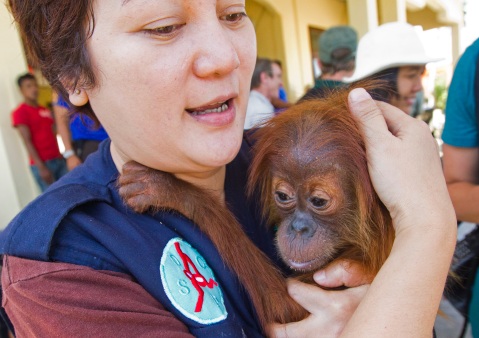
Confiscation of infant orangutan from wildlife traders in Aceh Province, Sumatra.

on Saturday, June 16, 2012


16 June 2012
Press Release – For immediate distribution
Confiscation of infant orangutan from wildlife traders in Aceh Province, Sumatra.

[Babahrot, Aceh Barat Daya, Aceh Province, Indonesia] Today, 16th of July, a team involving staff from the Sumatran Orangutan Conservation Program, Local Police, and relevant Government authorities confiscated an infant male Orangutan from traders who had been attempting to sell it to an undercover wildlife trafficking investigation team earlier in the week.

“Tripa is home to the highest population density of Orangutans found anywhere on earth” Said Dr Ian Singleton, Conservation Director of the Sumatran Orangutan Conservation Program.  Todays rescue was a great success and a fantastic collaboration from the police and various agencies involved. This little Orangutan is one of the lucky ones, and for the team, one of two during the past 48 hours in from Tripa.”
“In 1990 we estimate there was almost 2000 Orangutans in the Tripa Peat forest, and now today it could be less than 200 due to the ongoing and often illegal clearance of forest through the conversion to palm oil plantations. Satellite imagery obtained shows over 1500 hectares of conversion in the last 6 months in Tripa alone, and our ground team has reported ongoing fires and illegal activity of operations in palm oil concessions despite a central government investigation into their behavior.”

“Saturdays confiscation was the second orangutan rescued in as many days from Tripa, with a sub-adult male about 15 years old named Harry, now safely relocated to Jantho on the 15/06 due his forest home being encroached by a rising sea of palm oil, and field reports of fires still being used to clear forest inside the protected Leuser Ecosystem.

“This young orangutan is very thin, but otherwise active and has a good appetite. We are confident he will be fit and well in no time and he can now look forward to a long life in the wild after he is eventually released, instead if a very short life had stayed with his previous owner” concluded Dr. Ian Singleton.
“Orangutan is protected endangered wildlife and should not be captured, kept as pets or traded. This confiscation has helped to raise awareness of the community that they should not injure, capture, trade or keep Orangutan or other protected wildlife as pets.” Said Nurdin from BKSDA.

“We are vey happy with the success and outcome from todays activity”. Said Eko Budi, Head of Abdya District Police “the wildlife and its habitat is interwoven, and the community should not destroy it because on the legal aspect its violating the law plus if community damaged the environment, the community itself who will have to deal with the impact of the environmental damage.”

“The rescues of these two Orangutans has been a great collaboration from Community, Police, NGO and Government Departments” Added Farwiza from BPKEL “We are happy to see the effective and successful action of all involved. To provide best conditions for Wildlife, Community and Environment it is important the National Spatial Planning Law 26/2007 is actually followed, and Tripa is restored as it forms an important part of the protected Leuser Ecosystem. Read more: endoftheicons.wordpress.com

Related Posts Plugin for WordPress, Blogger...

Blog Ping