Malaysia seizes million-dollar ivory shipment: Customs

on Tuesday, December 13, 2011


KUALA LUMPUR - Malaysia has seized elephant tusks and ivory handicrafts worth an estimated four million ringgit (S$1.6 million) en route from Kenya to Cambodia, a customs official said Tuesday.
The haul is the latest to indicate Malaysia has become an Asian transit hub in the illicit ivory trade, and follows the seizure of hundreds of African elephants' tusks in several busts by Malaysian authorities in recent months.
Customs inspectors seized the container last Thursday in Klang, Malaysia's biggest port, after it was unloaded from a cargo ship.

"The cargo manifest said the container contained handicrafts (soapstone) and it was loaded in Mombasa port in Kenya," Azis Yacub, state customs director of the state of Selangor, where the port is located, said in a statement.

Officials also found carved elephant and rhinoceros ivory. Azis said the container's final destination was the port of Sihanoukville in Cambodia.
In August, Hong Kong authorities seized nearly two tonnes of elephant ivory worth about $1.7 million in a shipment from Malaysia, which wildlife trade monitoring network TRAFFIC has described as a major hub for illicit wildlife products.

TRAFFIC says that the illegal ivory trade has been rising globally since 2004 largely due to increasing demand in China, where ivory is often ground up and used in traditional medicine.

International trade in elephant ivory was banned in 1990, but since then several auctions of tusks from elephants that died naturally or were seized from poachers have been permitted in Namibia, Botswana and South Africa.

Resource :  AFP

PANGOLIN MEAT WORTH RM3.9m SEIZED

on Friday, December 9, 2011


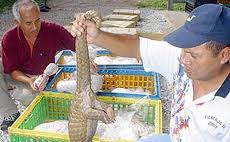
SANDAKAN: The newly-formed customs marine special team has seized frozen Pangolin meat worth about RM3.9 million.

The meat, weighing close to five tonnes (4,988 kilogrammes) was seized from a jongkong (long boat) after a brief pursuit in the Batu Sapi waters near Kampung Bahagia here on Wednesday.
“This is the biggest seizure of Pangolin meat by Sabah customs,” deputy state customs director Hamzah Sundang told a press conference here yesterday.

He said the success came on the second day of “Operasi Sempadan” involving the special team headed by senior customs officer Winston Julian and assisted by another senior officer Haji Saidin Jalaluddin.
The special team chased after the suspicious jongkong which was heading towards open sea at about 6.30pm on Wednesday.

After that, the long boat which was powered by two 200-horsepower engines then turned around and sped towards the shore.

The 40-feet long boat rammed into the shore after several men onboard jumped into the water to escape.
The special team managed to detain one suspect, an 18-year-old Filipino, and later found 178 cartons containing the meat of 1,068 Pangolins on the abandoned boat.

“Preliminary investigation revealed the jongkong was transporting the semi-processed Pangolin meat from Sandakan to the nearby Philippine island of Taganak,” Hamzah said.
He added that they are investigating to identify those responsible including where the Pangolin meat is from and its actual destination.

He said the Pangolin meat is worth RM 3,987,200 in the international market while the jongkong and the two outboard engines, RM 100,000. The case is being investigated under Section 135 (i) (e) of the Customs Act 1967.

Hamzah, meanwhile said they would continue to beef up operations against smuggling activities.
And, he also urged members of the public with information on such activities to inform the department.
“This is shocking,” Tourism, Culture and Environment Minister Datuk Masidi Manjun said when contacted by News Sabah Times yesterday.

“There is something wrong with enforcement. You cannot possible attempt to smuggle out so much Pangolin meat,” he said.

Resource :  New Sabah Times

In pictures: Malaysian illicit wildlife trade

on Tuesday, November 22, 2011


Pangolins: Natural Pest Controllers and Soil Caretakers

Pangolins play an important ecological role, providing ‘pest’ control and improving soil quality.

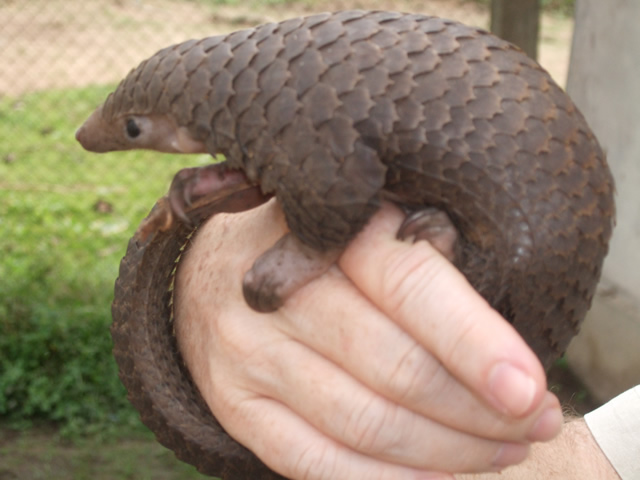
What the heck is a pangolin? Aside from being a very unique, insectivorous creature and the most trafficked mammal in the international illegal wildlife trade, these scaly anteaters also have a job — a very important one!

Pangolins provide earth with all-natural pest control and are fantastic tenders of soil, and they do these things simply through their everyday behaviors. Tens of millions of years of pangolin evolution have produced an incredible specimen that is perfectly adapted for the niche they occupy. 

Their mere presence, in conjunction with that of the other organisms and processes within the habitat they live in, is absolutely imperative to continued healthy ecosystem functioning.

Pangolins are soil caretakers

Their large and elongated claws enable them to burrow underground for shelter and to excavate ant and termite nests for food. In doing so, the soil is mixed and aerated—much like what happens when we rototill gardens or plow crop fields.

This improves the nutrient quality of the soil and aids the decomposition cycle, providing a healthy substrate for lush vegetation to grow from. When abandoned, their underground burrows also provide habitat for other animals.

Forget the exterminator, call in the pangolin!


It is said that a single pangolin consumes as much as 70 million insects per year—mainly ants and termites. Seventy million! That’s about 191,780 insects per day! Imagine an area that is home to 15 pangolins. Those animals alone could potentially eat as many as 1.05 billion insects annually! 

Comparatively, the U.S. National Park Service says individuals of some bat species are said to eat as many as 3,000 bugs each night, which could mean a total of almost 1.1 million a year. As you can imagine, pangolins certainly help to control their insect prey’s numbers, contributing to the delicate balance of the ecosystems they inhabit. 

However, humans also benefit from the pangolin’s work. Researchers at Ohio State University claim billions of dollars are spent annually on repairing termite damage and treating and preventing infestations. Healthy populations of scaly anteaters throughout their historic range can help to alleviate these problems.

Don’t fire the pangolins!

Ecosystems are maintained only when all of their components—biotic and abiotic—work synergistically, with each one doing its “job”. The extinction of pangolins may seem like a minimal loss, but the more parts you remove from a system, the closer it becomes to collapse.

Poaching pangolins to supply black market demand for their flesh, scales, and fetuses—which stems from East and Southeast Asia, particularly China and Vietnam—has become the number one threat to these magnificent creatures. This threat is closely followed by habitat loss. Daily, we are inching closer and closer to losing pangolins forever, as a result.

The existence of forests where pangolins “work” and live relies on these insectivores to do their “jobs”. It’s up to us to make sure pangolins aren’t exterminated, themselves!

Watch some pangolin pest control in action in this video from National Geographic!


Resource: pangolins.org

Wildlife Dept Seizes Over 900 Protected Animals

on Thursday, November 17, 2011


The Department of Wildlife and National Parks seized over 900 protected animals valued at about RM35,000 in a raid on a cowshed in Jalan Lama Riverside, Bedong, yesterday.

Kedah Wildlife and National Parks director Rahim Ahmad said today monitor lizards and snakes were found in a cage that was hidden in a container while tortoises were found in plastic baskets near the cowshed.
He said the raid was conducted at 2 pm after the cowshed was placed under surveillance for several days following a tip-off that wild animals were being kept for sale at the premises.

“Among the animals seized were 287 monitor lizards, 189 snakes, 30 tortoises, 272 coura amboinesis tortoises and 124 big tortoises,” he told reporters.

Members of the public with information on crimes related to protected animals can contact the Kedah Wildlife and National Parks Department at 04-7312200, he said.

Resource: Bernama

Related Posts Plugin for WordPress, Blogger...

Blog Ping